War of oars
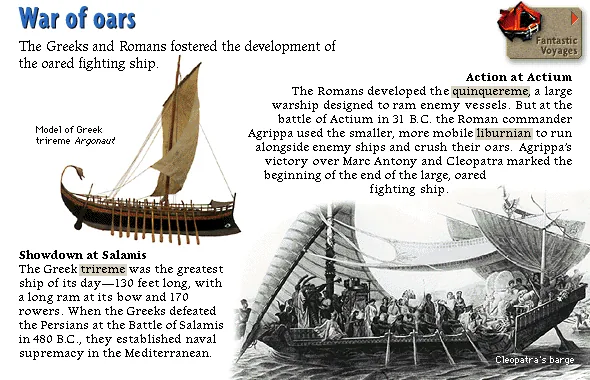
The Greeks and Romans fostered the development of the oared fighting ship.
From ancient oars to nuclear submarines, humans have been building—and battling—on the seas for 4,000 years!
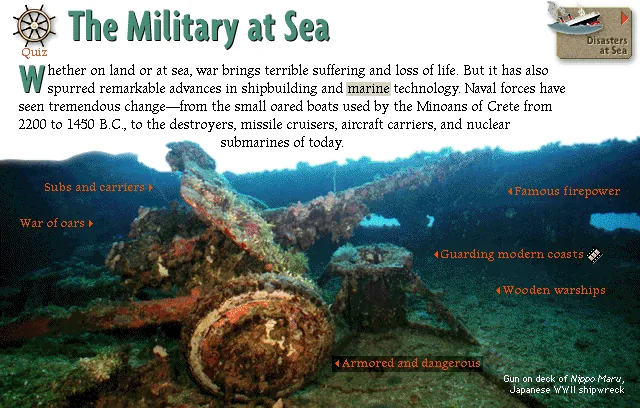
Whether on land or at sea, war brings terrible suffering and loss of life. But it has also spurred remarkable advances in shipbuilding and marine technology. Naval forces have seen tremendous change—from the small oared boats used by the Minoans of Crete from 2200 to 1450 B.C., to the destroyers, missile cruisers, aircraft carriers, and nuclear submarines of today.

The Greeks and Romans fostered the development of the oared fighting ship.

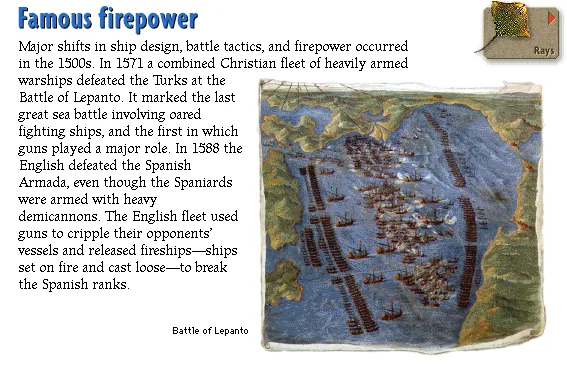
Major shifts in ship design, battle tactics, and firepower occurred in the 1500s. In 1571 a combined Christian fleet of heavily armed warships defeated the Turks at the Battle of Lepanto. It marked the last great sea battle involving oared fighting ships, and the first in which guns played a major role. In 1588 the English defeated the Spanish Armada, even though the Spaniards were armed with heavy demicannons. The English fleet used guns to cripple their opponents' vessels and released fireships—ships set on fire and cast loose—to break the Spanish ranks.

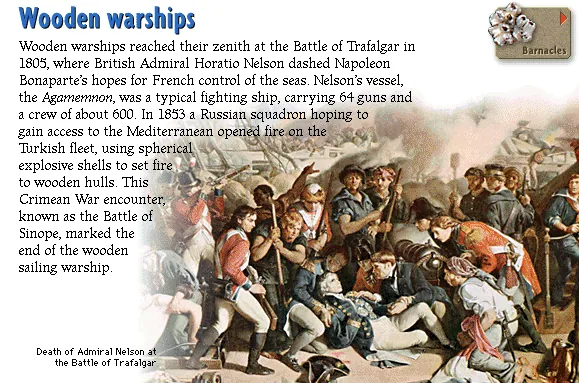
Wooden warships reached their zenith at the Battle of Trafalgar in 1805, where British Admiral Horatio Nelson dashed Napoleon Bonaparte's hopes for French control of the seas. Nelson's vessel, the Agamemnon, was a typical fighting ship, carrying 64 guns and a crew of about 600. In 1853 a Russian squadron hoping to gain access to the Mediterranean opened fire on the Turkish fleet, using spherical explosive shells to set fire to wooden hulls. This Crimean War encounter, known as the Battle of Sinope, marked the end of the wooden sailing warship.

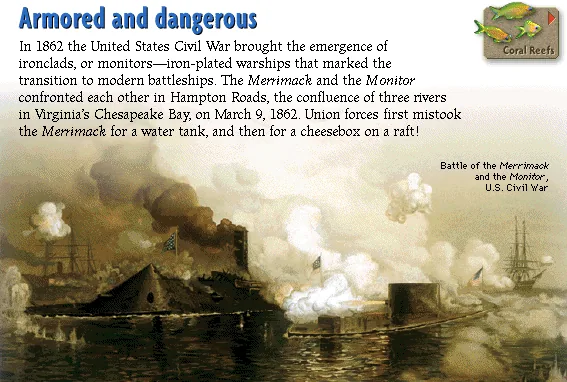
In 1862 the United States Civil War brought the emergence of ironclads, or monitors—iron-plated warships that marked the transition to modern battleships. The Merrimack and the Monitor confronted each other in Hampton Roads, the confluence of three rivers in Virginia's Chesapeake Bay, on March 9, 1862. Union forces first mistook the Merrimack for a water tank, and then for a cheesebox on a raft!

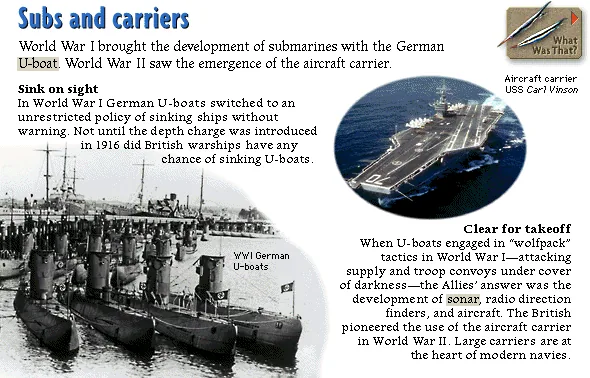
World War I brought the development of submarines with the German U-boat. World War II saw the emergence of the aircraft carrier.
Guarding modern coasts — U.S. Coast Guard rescue effort
Source: Microsoft Oceans (1995) CD-ROM. Text liberated from original screen art; images, audio & clips restored from disc. Original media is Microsoft/supplier copyright — non-commercial educational preservation. Credits & Acknowledgements