Heads up
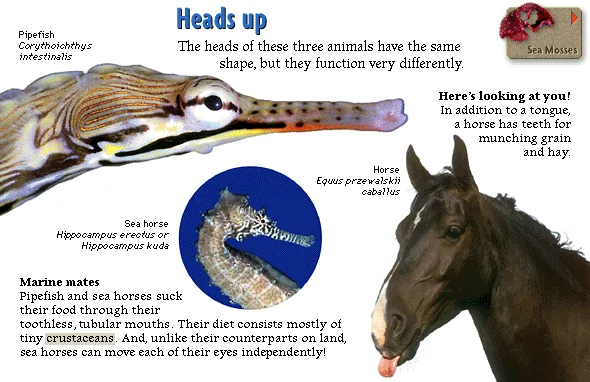
The heads of these three animals have the same shape, but they function very differently.
Part horse, part fish, and totally surprising — meet the ocean's slowest-motion knights!
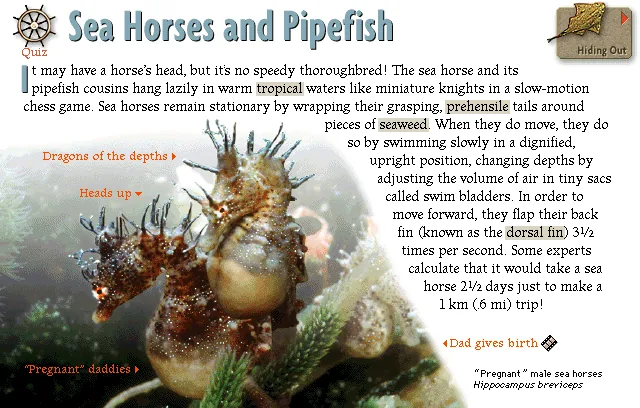
It may have a horse's head, but it's no speedy thoroughbred! The sea horse and its pipefish cousins hang lazily in warm tropical waters like miniature knights in a slow-motion chess game. Sea horses remain stationary by wrapping their grasping, prehensile tails around pieces of seaweed. When they do move, they do so by swimming slowly in a dignified, upright position, changing depths by adjusting the volume of air in tiny sacs called swim bladders. In order to move forward, they flap their back fin (known as the dorsal fin) 3½ times per second. Some experts calculate that it would take a sea horse 2½ days just to make a 1 km (6 mi) trip!

The heads of these three animals have the same shape, but they function very differently.

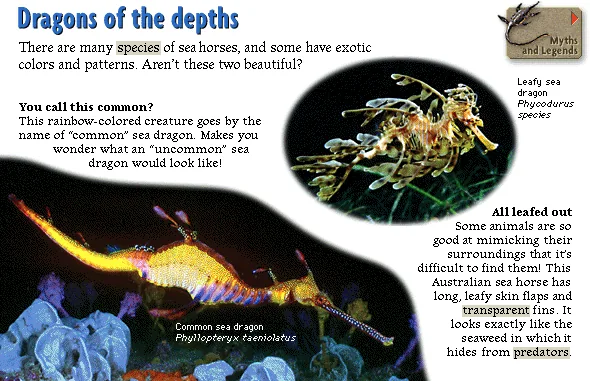
There are many species of sea horses, and some have exotic colors and patterns. Aren't these two beautiful?

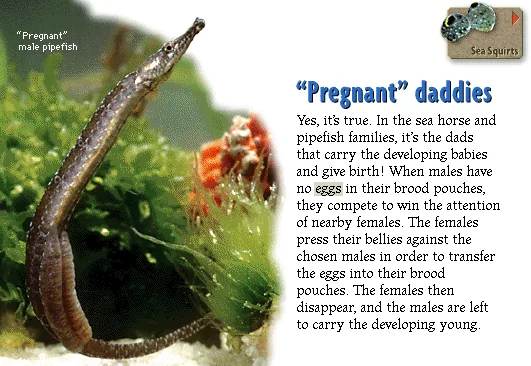
Yes, it's true. In the sea horse and pipefish families, it's the dads that carry the developing babies and give birth! When males have no eggs in their brood pouches, they compete to win the attention of nearby females. The females press their bellies against the chosen males in order to transfer the eggs into their brood pouches. The females then disappear, and the males are left to carry the developing young.
Dad gives birth — The male sea horse carries the eggs from 10 to 45 days, depending on the species, then gives birth to baby sea horses that look exactly like adults, but are no more than 1 cm (.4 in) long! Neither parent hangs around long after birth, so these tiny creatures have to fend for themselves. If all the marine plants were stripped from the ocean floor, baby seahorses would have nowhere to hide from predators.
Source: Microsoft Oceans (1995) CD-ROM. Text liberated from original screen art; images, audio & clips restored from disc. Original media is Microsoft/supplier copyright — non-commercial educational preservation. Credits & Acknowledgements