Microsoft Oceans
Sailing Ships
Sailing Ships

From a hollowed log to a high-tech yacht — humans have been chasing the wind for thousands of years!

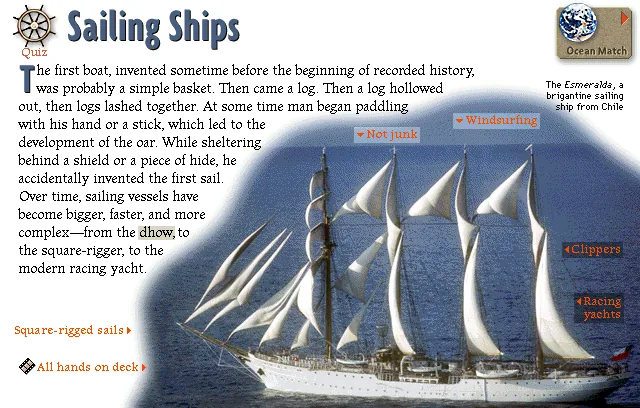
The first boat, invented sometime before the beginning of recorded history, was probably a simple basket. Then came a log. Then a log hollowed out, then logs lashed together. At some time man began paddling with his hand or a stick, which led to the development of the oar. While sheltering behind a shield or a piece of hide, he accidentally invented the first sail. Over time, sailing vessels have become bigger, faster, and more complex—from the dhow, to the square-rigger, to the modern racing yacht.

Explore

Not junk

Not junk

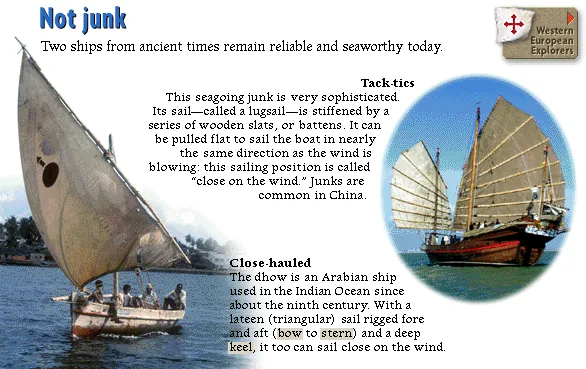
Two ships from ancient times remain reliable and seaworthy today.

Tack-tiesThis seagoing junk is very sophisticated. Its sail—called a lugsail—is stiffened by a series of wooden slats, or battens. It can be pulled flat to sail the boat in nearly the same direction as the wind is blowing; this sailing position is called "close on the wind." Junks are common in China.
Close-hauledThe dhow is an Arabian ship used in the Indian Ocean since about the ninth century. With a lateen (triangular) sail rigged fore and aft (bow to stern) and a deep keel, it too can sail close on the wind.
Square-rigged sails

Square-rigged sails

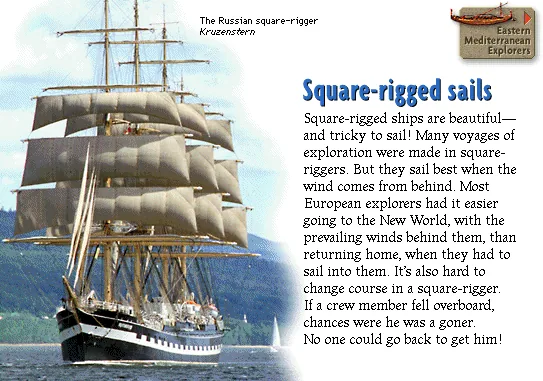
Square-rigged ships are beautiful—and tricky to sail! Many voyages of exploration were made in square-riggers. But they sail best when the wind comes from behind. Most European explorers had it easier going to the New World, with the prevailing winds behind them, than returning home, when they had to sail into them. It's also hard to change course in a square-rigger. If a crew member fell overboard, chances were he was a goner. No one could go back to get him!

Clippers

Clippers

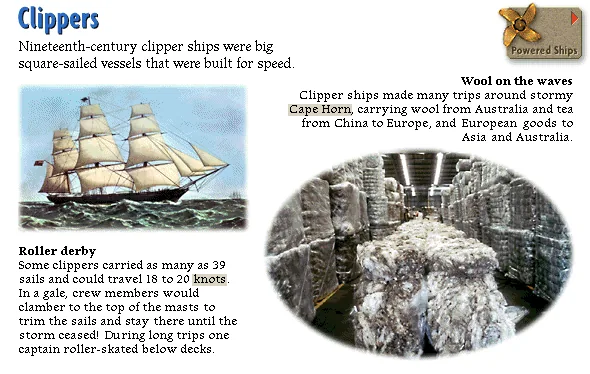
Nineteenth-century clipper ships were big square-sailed vessels that were built for speed.

Roller derbySome clippers carried as many as 39 sails and could travel 18 to 20 knots. In a gale, crew members would clamber to the top of the masts to trim the sails and stay there until the storm ceased! During long trips one captain roller-skated below decks.
Wool on the wavesClipper ships made many trips around stormy Cape Horn, carrying wool from Australia and tea from China to Europe, and European goods to Asia and Australia.
Racing yachts

Racing yachts

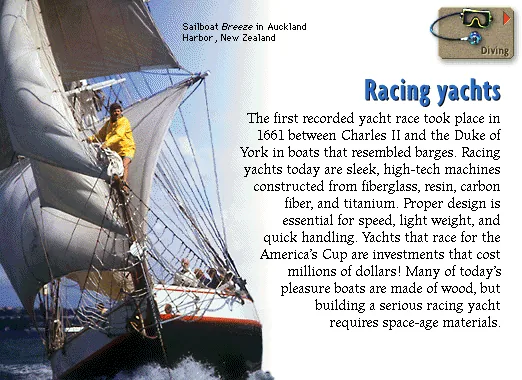
The first recorded yacht race took place in 1661 between Charles II and the Duke of York in boats that resembled barges. Racing yachts today are sleek, high-tech machines constructed from fiberglass, resin, carbon fiber, and titanium. Proper design is essential for speed, light weight, and quick handling. Yachts that race for the America's Cup are investments that cost millions of dollars! Many of today's pleasure boats are made of wood, but building a serious racing yacht requires space-age materials.

Windsurfing

Windsurfing

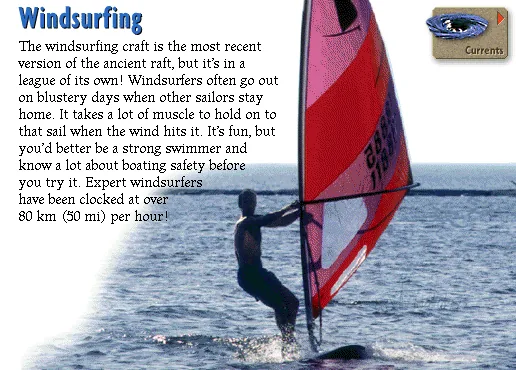
The windsurfing craft is the most recent version of the ancient raft, but it's in a league of its own! Windsurfers often go out on blustery days when other sailors stay home. It takes a lot of muscle to hold on to that sail when the wind hits it. It's fun, but you'd better be a strong swimmer and know a lot about boating safety before you try it. Expert windsurfers have been clocked at over 80 km (50 mi) per hour!

Watch

All hands on deck — Today there are training ships in many countries that look and sail like square-riggers. The trainees on these ships must have muscle power and can't be afraid of heights. It takes a lot of people and a lot of work to handle all those sails!

Source: Microsoft Oceans (1995) CD-ROM. Text liberated from original screen art; images, audio & clips restored from disc. Original media is Microsoft/supplier copyright — non-commercial educational preservation. Credits & Acknowledgements