Microsoft Oceans
Sea Senses
Sea Senses

Under the sea, every sense gets a super upgrade.

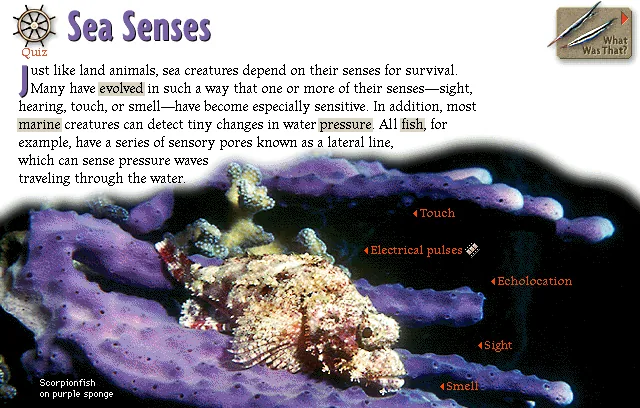
Just like land animals, sea creatures depend on their senses for survival. Many have evolved in such a way that one or more of their senses—sight, hearing, touch, or smell—have become especially sensitive. In addition, most marine creatures can detect tiny changes in water pressure. All fish, for example, have a series of sensory pores known as a lateral line, which can sense pressure waves traveling through the water.

Explore

Sight

Sight

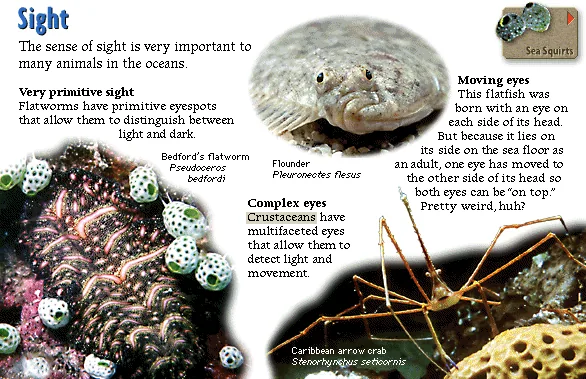
The sense of sight is very important to many animals in the oceans. Very primitive sight Flatworms have primitive eyespots that allow them to distinguish between light and dark. Complex eyes Crustaceans have multifaceted eyes that allow them to detect light and movement. Moving eyes This flatfish was born with an eye on each side of its head. But because it lies on its side on the sea floor as an adult, one eye has moved to the other side of its head so both eyes can be "on top." Pretty weird, huh?

Bedford's flatwormPseudoceros bedfordi
FlounderPleuronectes flesus
Caribbean arrow crabStenorhynchus seticornis
Echolocation

Echolocation

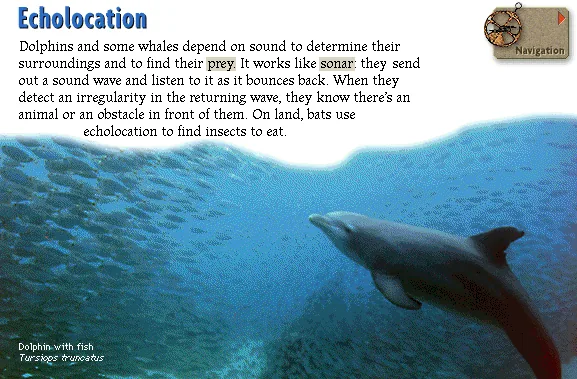
Dolphins and some whales depend on sound to determine their surroundings and to find their prey. It works like sonar: they send out a sound wave and listen to it as it bounces back. When they detect an irregularity in the returning wave, they know there's an animal or an obstacle in front of them. On land, bats use echolocation to find insects to eat.

Dolphin with fishTursiops truncatus
Smell

Smell

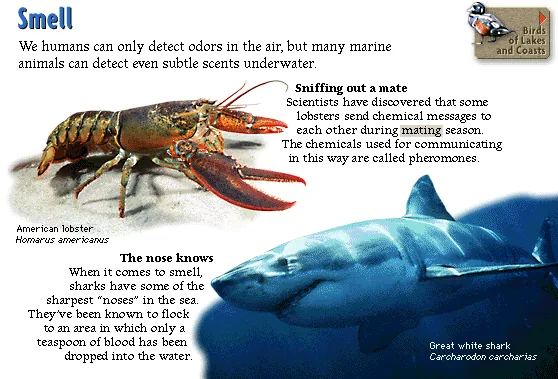
We humans can only detect odors in the air, but many marine animals can detect even subtle scents underwater. Sniffing out a mate Scientists have discovered that some lobsters send chemical messages to each other during mating season. The chemicals used for communicating in this way are called pheromones. The nose knows When it comes to smell, sharks have some of the sharpest "noses" in the sea. They've been known to flock to an area in which only a teaspoon of blood has been dropped into the water.

American lobsterHomarus americanus
Great white sharkCarcharodon carcharias
Touch

Touch

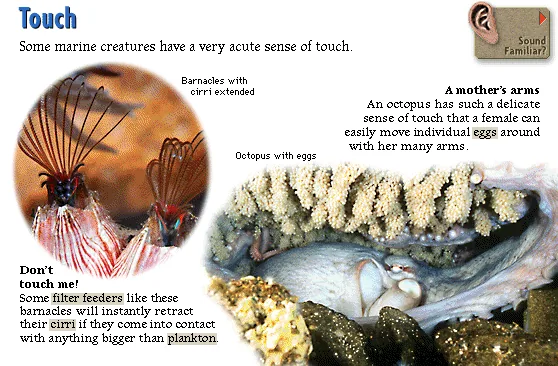
Some marine creatures have a very acute sense of touch. Don't touch me! Some filter feeders like these barnacles will instantly retract their cirri if they come into contact with anything bigger than plankton. A mother's arms An octopus has such a delicate sense of touch that a female can easily move individual eggs around with her many arms.

Barnacles with cirri extendedBarnacles with cirri extended
Octopus with eggsOctopus with eggs

Watch

Electrical pulses — All living creatures emit low-level electrical pulses, and some marine creatures are able to use this electricity to their advantage. Hammerhead sharks can even detect the electrical pulses of prey buried under sand or mud. Electric rays seem to create a kind of electrical "force field" around themselves — if they sense a disruption in the electrical field, they may send out a strong burst of electricity to stun the intruder.

Source: Microsoft Oceans (1995) CD-ROM. Text liberated from original screen art; images, audio & clips restored from disc. Original media is Microsoft/supplier copyright — non-commercial educational preservation. Credits & Acknowledgements