Microsoft Oceans
South Pacific Explorers

Stars were their compass — Polynesian sailors crossed the mighty Pacific thousands of years ago without any maps.

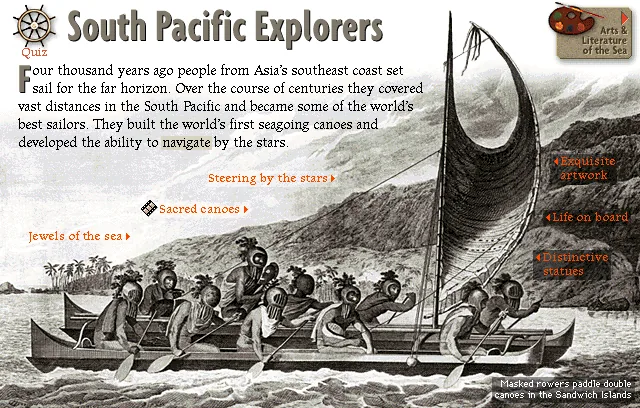
Four thousand years ago people from Asia's southeast coast set sail for the far horizon. Over the course of centuries they covered vast distances in the South Pacific and became some of the world's best sailors. They built the world's first seagoing canoes and developed the ability to navigate by the stars.

Explore

Life on board

Life on board

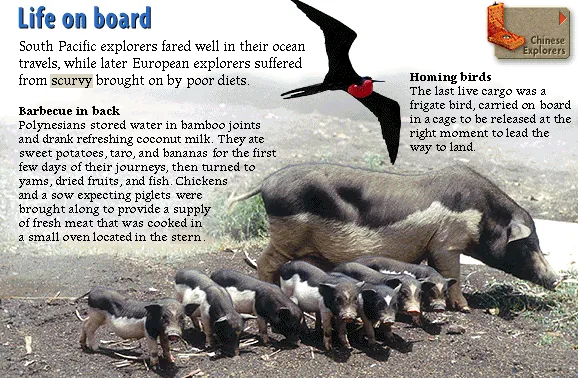
South Pacific explorers fared well in their ocean travels, while later European explorers suffered from scurvy brought on by poor diets. Barbecue in back Polynesians stored water in bamboo joints and drank refreshing coconut milk. They ate sweet potatoes, taro, and bananas for the first few days of their journeys, then turned to yams, dried fruits, and fish. Chickens and a sow expecting piglets were brought along to provide a supply of fresh meat that was cooked in a small oven located in the stern.

Homing birdsThe last live cargo was a frigate bird, carried on board in a cage to be released at the right moment to lead the way to land.
Exquisite artwork

Exquisite artwork

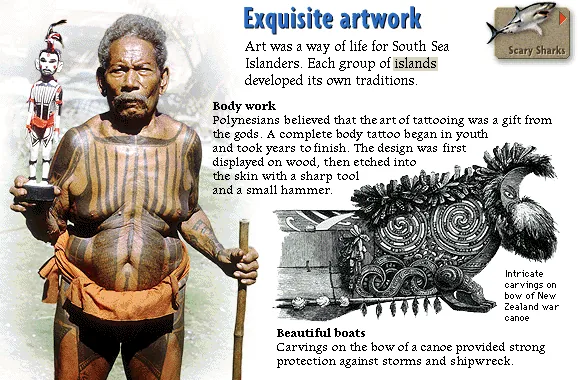
Art was a way of life for South Sea Islanders. Each group of islands developed its own traditions. Body work Polynesians believed that the art of tattooing was a gift from the gods. A complete body tattoo began in youth and took years to finish. The design was first displayed on wood, then etched into the skin with a sharp tool and a small hammer. Beautiful boats Carvings on the bow of a canoe provided strong protection against storms and shipwreck.

Intricate carvingsIntricate carvings on bow of New Zealand war canoe
Steering by the stars

Steering by the stars

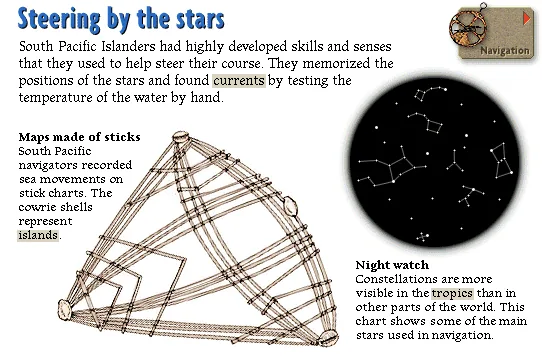
South Pacific Islanders had highly developed skills and senses that they used to help steer their course. They memorized the positions of the stars and found currents by testing the temperature of the water by hand. Maps made of sticks South Pacific navigators recorded sea movements on stick charts. The cowrie shells represent islands.

Night watchConstellations are more visible in the tropics than in other parts of the world. This chart shows some of the main stars used in navigation.
Jewels of the sea

Jewels of the sea

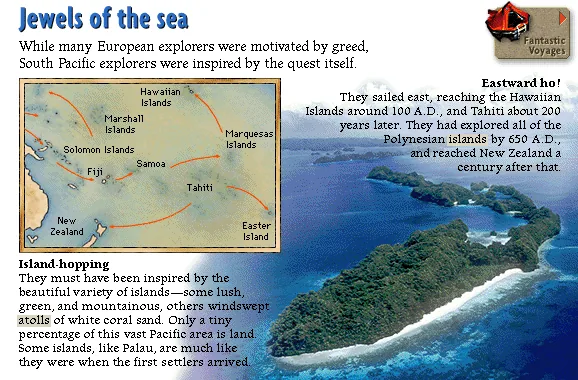
While many European explorers were motivated by greed, South Pacific explorers were inspired by the quest itself. Island-hopping They must have been inspired by the beautiful variety of islands—some lush, green, and mountainous, others windswept atolls of white coral sand. Only a tiny percentage of this vast Pacific area is land. Some islands, like Palau, are much like they were when the first settlers arrived.

Eastward ho!They sailed east, reaching the Hawaiian Islands around 100 A.D., and Tahiti about 200 years later. They had explored all of the Polynesian islands by 650 A.D., and reached New Zealand a century after that.
Distinctive statues

Distinctive statues

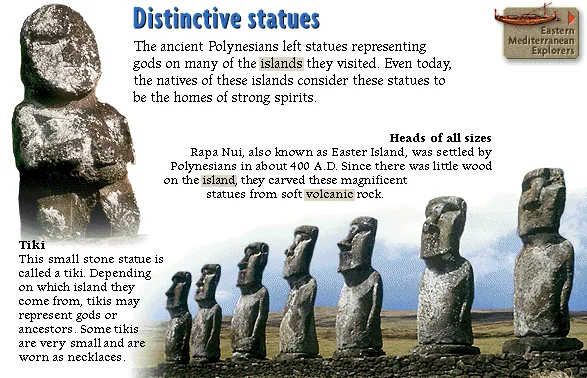
The ancient Polynesians left statues representing gods on many of the islands they visited. Even today, the natives of these islands consider these statues to be the homes of strong spirits.

TikiThis small stone statue is called a tiki. Depending on which island they come from, tikis may represent gods or ancestors. Some tikis are very small and are worn as necklaces.
Heads of all sizesRapa Nui, also known as Easter Island, was settled by Polynesians in about 400 A.D. Since there was little wood on the island, they carved these magnificent statues from soft volcanic rock.

Watch

Sacred canoes — The seagoing canoe was more than a means of transportation to ancient Polynesians—it was a sacred vessel. Canoe builders fasted and prayed while they worked. Islanders believed that certain fish were sent by the gods, and the bows of fishing canoes were carved to resemble bonitos (a relative of the tuna). Today the art of building traditional canoes is carried on by a small number of Polynesians.

Source: Microsoft Oceans (1995) CD-ROM. Text liberated from original screen art; images, audio & clips restored from disc. Original media is Microsoft/supplier copyright — non-commercial educational preservation. Credits & Acknowledgements