Microsoft Oceans
Western European Explorers

Daring sailors who crossed impossible oceans and changed the world forever.

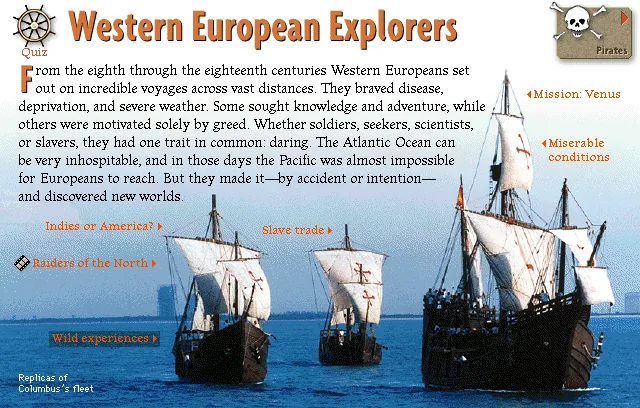
From the eighth through the eighteenth centuries Western Europeans set out on incredible voyages across vast distances. They braved disease, deprivation, and severe weather. Some sought knowledge and adventure, while others were motivated solely by greed. Whether soldiers, seekers, scientists, or slavers, they had one trait in common: daring. The Atlantic Ocean can be very inhospitable, and in those days the Pacific was almost impossible for Europeans to reach. But they made it—by accident or intention—and discovered new worlds.

Explore

Indies or America?

Indies or America?

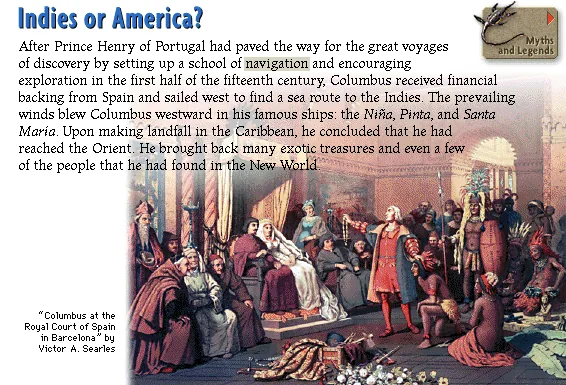
After Prince Henry of Portugal had paved the way for the great voyages of discovery by setting up a school of navigation and encouraging exploration in the first half of the fifteenth century, Columbus received financial backing from Spain and sailed west to find a sea route to the Indies. The prevailing winds blew Columbus westward in his famous ships: the Niña, Pinta, and Santa Maria. Upon making landfall in the Caribbean, he concluded that he had reached the Orient. He brought back many exotic treasures and even a few of the people that he had found in the New World.

"Columbus at the Royal Court of Spain in Barcelona"by Victor A. Searles
Slave trade

Slave trade

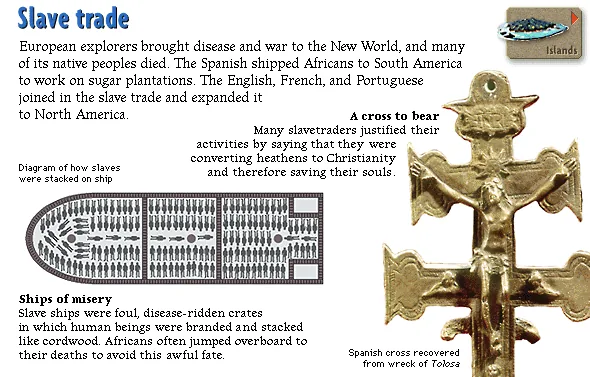
European explorers brought disease and war to the New World, and many of its native peoples died. The Spanish shipped Africans to South America to work on sugar plantations. The English, French, and Portuguese joined in the slave trade and expanded it to North America.

Ships of miserySlave ships were foul, disease-ridden crates in which human beings were branded and stacked like cordwood. Africans often jumped overboard to their deaths to avoid this awful fate.
A cross to bearMany slavetraders justified their activities by saying that they were converting heathens to Christianity and therefore saving their souls.
Miserable conditions

Miserable conditions

Sailing the long distance from Europe was not a luxury trip for anyone during the Age of Discovery.

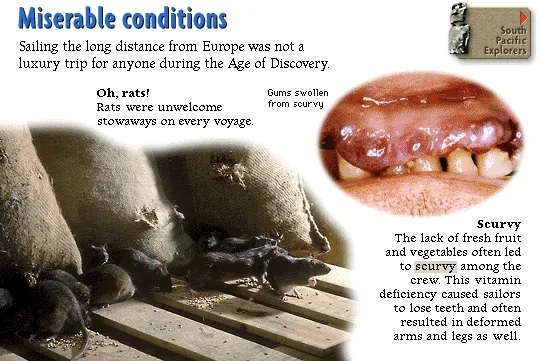
Oh, rats!Rats were unwelcome stowaways on every voyage.
ScurvyThe lack of fresh fruit and vegetables often led to scurvy among the crew. This vitamin deficiency caused sailors to lose teeth and often resulted in deformed arms and legs as well.
Wild experiences

Wild experiences

In 1520 Magellan ventured out of the straits which are now named after him and into the Pacific Ocean. His crew sailed for over a hundred days without taking on food or water. They even had to eat leather! But by enduring these hardships, they became the first to circumnavigate the globe.

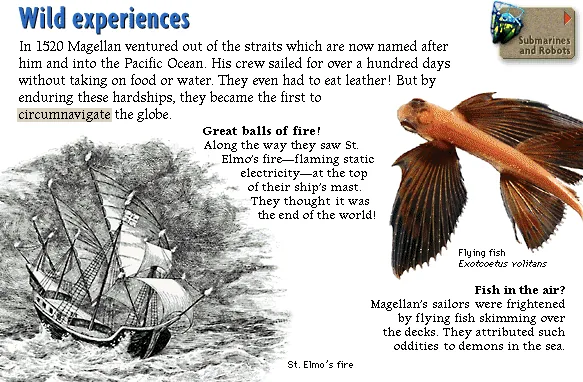
Great balls of fire!Along the way they saw St. Elmo's fire—flaming static electricity—at the top of their ship's mast. They thought it was the end of the world!
Fish in the air?Magellan's sailors were frightened by flying fish skimming over the decks. They attributed such oddities to demons in the sea.
Mission: Venus

Mission: Venus

Captain James Cook's quest was for knowledge, not for gold. In 1768 England's King George III sent him to the central Pacific to track Venus as it crossed the Sun.

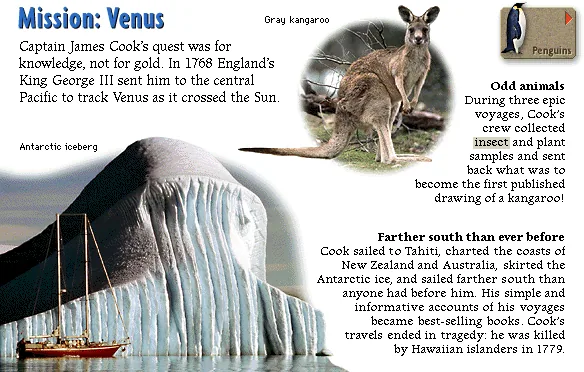
Odd animalsDuring three epic voyages, Cook's crew collected insect and plant samples and sent back what was to become the first published drawing of a kangaroo!
Farther south than ever beforeCook sailed to Tahiti, charted the coasts of New Zealand and Australia, skirted the Antarctic ice, and sailed farther south than anyone had before him. His simple and informative accounts of his voyages became best-selling books. Cook's travels ended in tragedy: he was killed by Hawaiian islanders in 1779.

Watch

Raiders of the North — Viking longships brave icy northern seas, ranging from Scandinavia to Greenland and eastern Canada, leaving hundreds of carved memorial stones as evidence of their journeys.

Dive deeper

Source: Microsoft Oceans (1995) CD-ROM. Text liberated from original screen art; images, audio & clips restored from disc. Original media is Microsoft/supplier copyright — non-commercial educational preservation. Credits & Acknowledgements