Microsoft Oceans
Lobsters
Lobsters
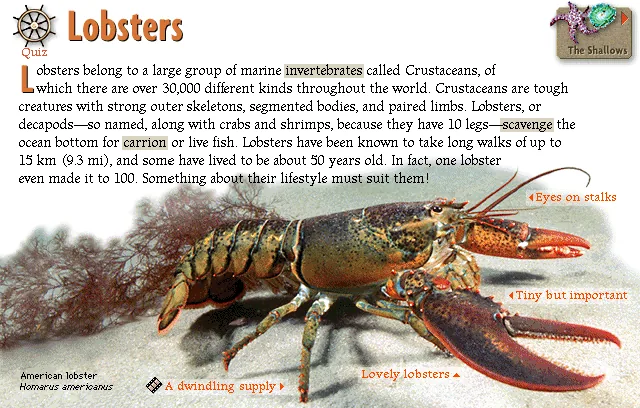
Homarus americanus

Armored ocean scavengers that can walk miles and live to 100!

Lobsters belong to a large group of marine invertebrates called Crustaceans, of which there are over 30,000 different kinds throughout the world. Crustaceans are tough creatures with strong outer skeletons, segmented bodies, and paired limbs. Lobsters, or decapods—so named, along with crabs and shrimps, because they have 10 legs—scavenge the ocean bottom for carrion or live fish. Lobsters have been known to take long walks of up to 15 km (9.3 mi), and some have lived to be about 50 years old. In fact, one lobster even made it to 100. Something about their lifestyle must suit them!

Explore

Lovely lobsters

Lovely lobsters

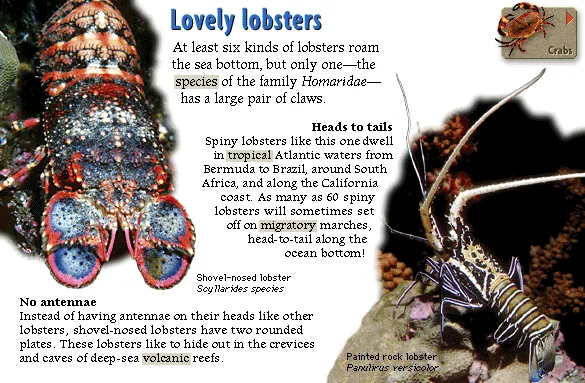
At least six kinds of lobsters roam the sea bottom, but only one—the species of the family Homaridae—has a large pair of claws. Heads to tails Spiny lobsters like this one dwell in tropical Atlantic waters from Bermuda to Brazil, around South Africa, and along the California coast. As many as 60 spiny lobsters will sometimes set off on migratory marches, head-to-tail along the ocean bottom! No antennae Instead of having antennae on their heads like other lobsters, shovel-nosed lobsters have two rounded plates. These lobsters like to hide out in the crevices and caves of deep-sea volcanic reefs.
Heads to tailsSpiny lobsters like this one dwell in tropical Atlantic waters from Bermuda to Brazil, around South Africa, and along the California coast. As many as 60 spiny lobsters will sometimes set off on migratory marches, head-to-tail along the ocean bottom!
No antennaeInstead of having antennae on their heads like other lobsters, shovel-nosed lobsters have two rounded plates. These lobsters like to hide out in the crevices and caves of deep-sea volcanic reefs.
Tiny but important

Tiny but important

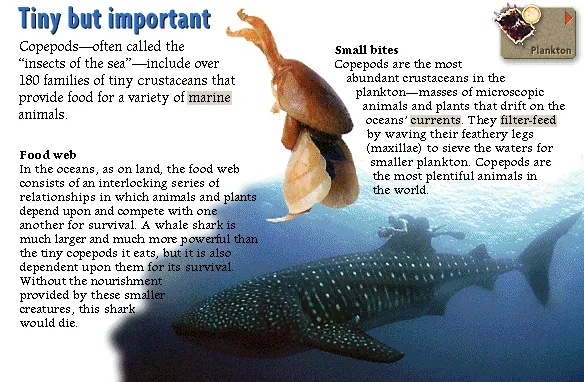
Copepods—often called the "insects of the sea"—include over 180 families of tiny crustaceans that provide food for a variety of marine animals. Food web In the oceans, as on land, the food web consists of an interlocking series of relationships in which animals and plants depend upon and compete with one another for survival. A whale shark is much larger and much more powerful than the tiny copepods it eats, but it is also dependent upon them for its survival. Without the nourishment provided by these smaller creatures, this shark would die. Small bites Copepods are the most abundant crustaceans in the plankton—masses of microscopic animals and plants that drift on the oceans' currents. They filter-feed by waving their feathery legs (maxillae) to sieve the waters for smaller plankton. Copepods are the most plentiful animals in the world.

Food webIn the oceans, as on land, the food web consists of an interlocking series of relationships in which animals and plants depend upon and compete with one another for survival. A whale shark is much larger and much more powerful than the tiny copepods it eats, but it is also dependent upon them for its survival. Without the nourishment provided by these smaller creatures, this shark would die.
Small bitesCopepods are the most abundant crustaceans in the plankton—masses of microscopic animals and plants that drift on the oceans' currents. They filter-feed by waving their feathery legs (maxillae) to sieve the waters for smaller plankton. Copepods are the most plentiful animals in the world.
Eyes on stalks

Eyes on stalks

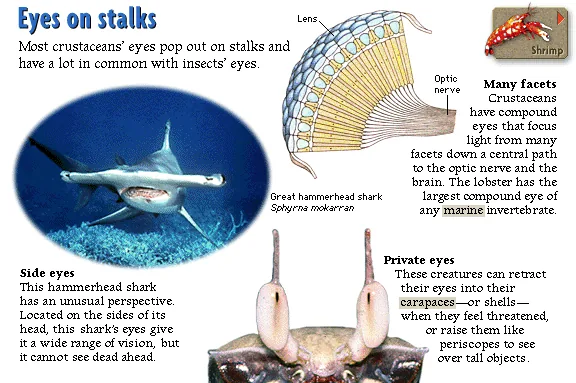
Most crustaceans' eyes pop out on stalks and have a lot in common with insects' eyes. Many facets Crustaceans have compound eyes that focus light from many facets down a central path to the optic nerve and the brain. The lobster has the largest compound eye of any marine invertebrate. Side eyes This hammerhead shark has an unusual perspective. Located on the sides of its head, this shark's eyes give it a wide range of vision, but it cannot see dead ahead. Private eyes These creatures can retract their eyes into their carapaces—or shells—when they feel threatened, or raise them like periscopes to see over tall objects.

Many facetsCrustaceans have compound eyes that focus light from many facets down a central path to the optic nerve and the brain. The lobster has the largest compound eye of any marine invertebrate.
Side eyesThis hammerhead shark has an unusual perspective. Located on the sides of its head, this shark's eyes give it a wide range of vision, but it cannot see dead ahead.
Private eyesThese creatures can retract their eyes into their carapaces—or shells—when they feel threatened, or raise them like periscopes to see over tall objects.

Watch

A dwindling supply — Lobsters have become such a popular treat that we are literally eating our way through the ocean's supply. American lobsters are often caught just off the coast in lobster pots—traps set by a tunnel of netting into which the lobster enters but can't escape. Fishing boats also trawl for lobsters that live in deeper waters. Some people are trying to raise lobsters in pens, but it's not yet known whether farming them will be successful.

Dive deeper

Source: Microsoft Oceans (1995) CD-ROM. Text liberated from original screen art; images, audio & clips restored from disc. Original media is Microsoft/supplier copyright — non-commercial educational preservation. Credits & Acknowledgements