Phytoplankton
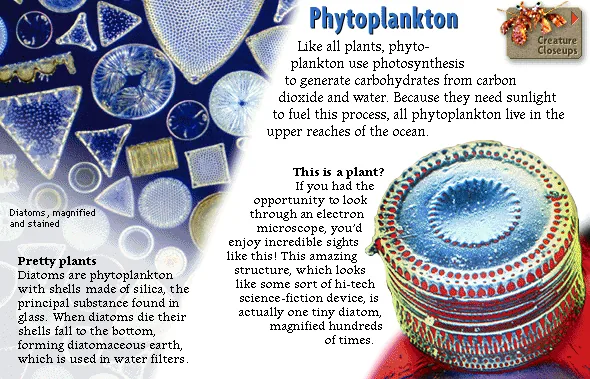
Like all plants, phytoplankton use photosynthesis to generate carbohydrates from carbon dioxide and water. Because they need sunlight to fuel this process, all phytoplankton live in the upper reaches of the ocean.
Tiny drifters that hold up the entire ocean food web!
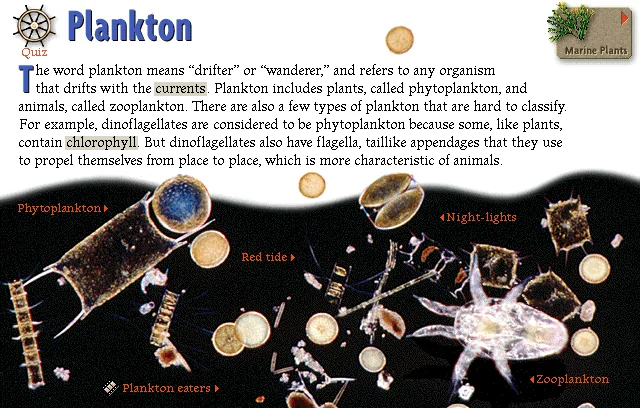
The word plankton means "drifter" or "wanderer," and refers to any organism that drifts with the currents. Plankton includes plants, called phytoplankton, and animals, called zooplankton. There are also a few types of plankton that are hard to classify. For example, dinoflagellates are considered to be phytoplankton because some, like plants, contain chlorophyll. But dinoflagellates also have flagella, taillike appendages that they use to propel themselves from place to place, which is more characteristic of animals.

Like all plants, phytoplankton use photosynthesis to generate carbohydrates from carbon dioxide and water. Because they need sunlight to fuel this process, all phytoplankton live in the upper reaches of the ocean.

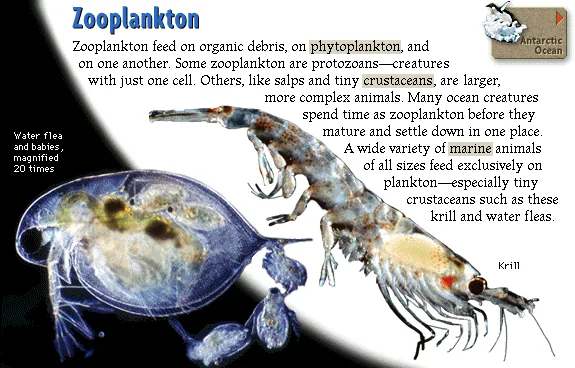
Zooplankton feed on organic debris, on phytoplankton, and on one another. Some zooplankton are protozoans—creatures with just one cell. Others, like salps and tiny crustaceans, are larger, more complex animals. Many ocean creatures spend time as zooplankton before they mature and settle down in one place. A wide variety of marine animals of all sizes feed exclusively on plankton—especially tiny crustaceans such as these krill and water fleas.

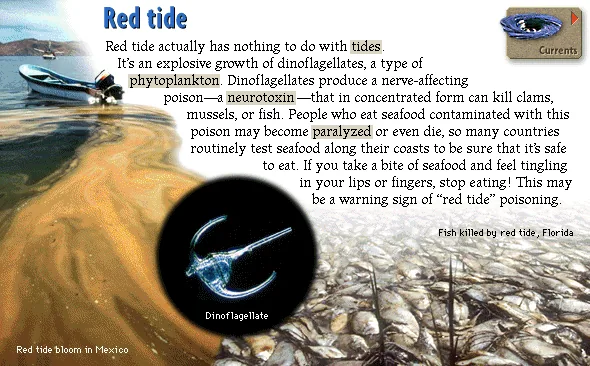
Red tide actually has nothing to do with tides. It's an explosive growth of dinoflagellates, a type of phytoplankton. Dinoflagellates produce a nerve-affecting poison—a neurotoxin—that in concentrated form can kill clams, mussels, or fish. People who eat seafood contaminated with this poison may become paralyzed or even die, so many countries routinely test seafood along their coasts to be sure that it's safe to eat. If you take a bite of seafood and feel tingling in your lips or fingers, stop eating! This may be a warning sign of "red tide" poisoning.

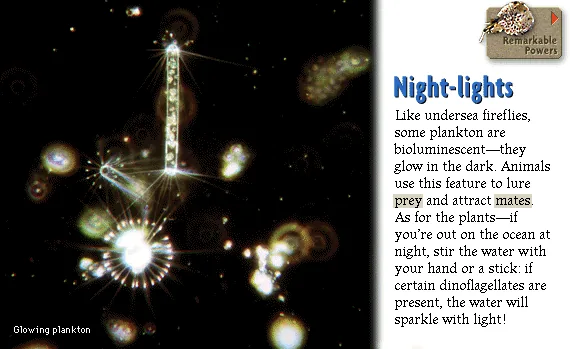
Like undersea fireflies, some plankton are bioluminescent—they glow in the dark. Animals use this feature to lure prey and attract mates. As for the plants—if you're out on the ocean at night, stir the water with your hand or a stick: if certain dinoflagellates are present, the water will sparkle with light!
Plankton eaters — Plankton form a rich soup on which many marine animals depend. Some plankton eaters, such as barnacles, corals, and sea mosses, stay in one place and strain out particles of plankton from the surrounding water. Others, such as baleen whales, whale sharks, basking sharks, and manta rays, are more mobile, and swim through the water with their mouths open to scoop up all the floating organisms they can.
Source: Microsoft Oceans (1995) CD-ROM. Text liberated from original screen art; images, audio & clips restored from disc. Original media is Microsoft/supplier copyright — non-commercial educational preservation. Credits & Acknowledgements