Microsoft Oceans
Spiral Shells
Spiral Shells

Built from seawater, guided by instinct — these shell-makers need no lessons.

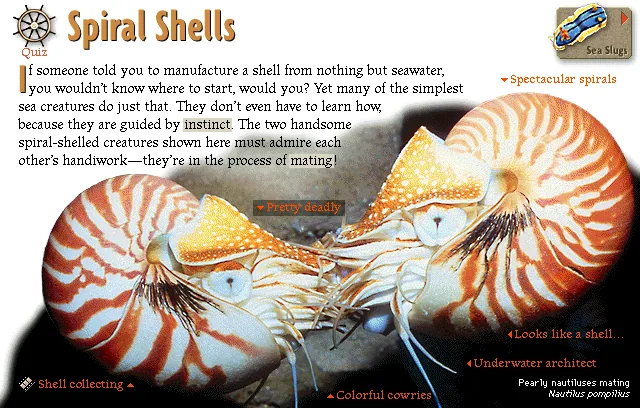
If someone told you to manufacture a shell from nothing but seawater, you wouldn't know where to start, would you? Yet many of the simplest sea creatures do just that. They don't even have to learn how, because they are guided by instinct. The two handsome spiral-shelled creatures shown here must admire each other's handiwork—they're in the process of mating!

Explore

Pretty deadly

Pretty deadly

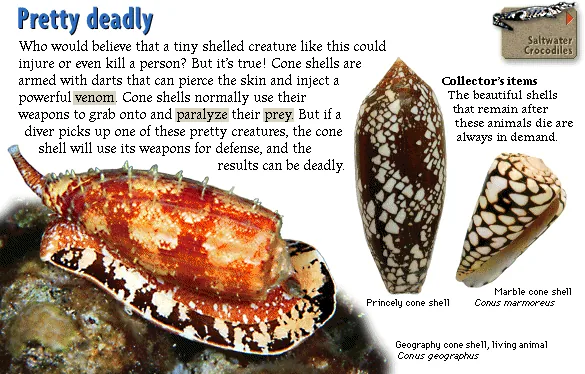
Who would believe that a tiny shelled creature like this could injure or even kill a person? But it's true! Cone shells are armed with darts that can pierce the skin and inject a powerful venom. Cone shells normally use their weapons to grab onto and paralyze their prey. But if a diver picks up one of these pretty creatures, the cone shell will use its weapons for defense, and the results can be deadly.

Collector's itemsThe beautiful shells that remain after these animals die are always in demand.
Underwater architect

Underwater architect

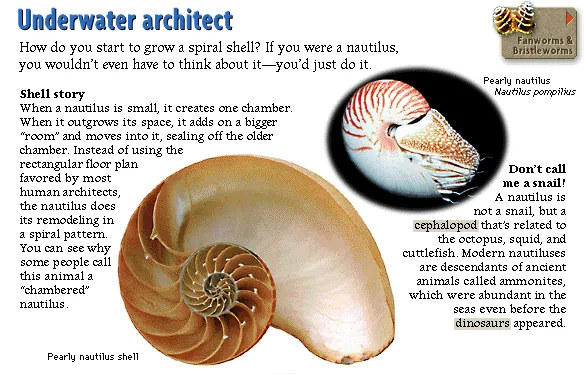
How do you start to grow a spiral shell? If you were a nautilus, you wouldn't even have to think about it—you'd just do it. Shell story When a nautilus is small, it creates one chamber. When it outgrows its space, it adds on a bigger "room" and moves into it, sealing off the older chamber. Instead of using the rectangular floor plan favored by most human architects, the nautilus does its remodeling in a spiral pattern. You can see why some people call this animal a "chambered" nautilus.

Don't call me a snail!A nautilus is not a snail, but a cephalopod that's related to the octopus, squid, and cuttlefish. Modern nautiluses are descendants of ancient animals called ammonites, which were abundant in the seas even before the dinosaurs appeared.
Looks like a shell...

Looks like a shell...

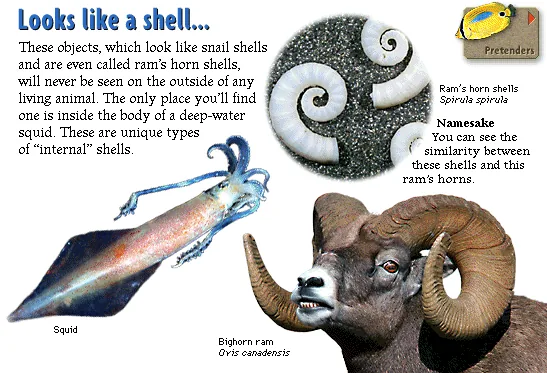
These objects, which look like snail shells and are even called ram's horn shells, will never be seen on the outside of any living animal. The only place you'll find one is inside the body of a deep-water squid. These are unique types of "internal" shells.

NamesakeYou can see the similarity between these shells and this ram's horns.
Spectacular spirals

Spectacular spirals

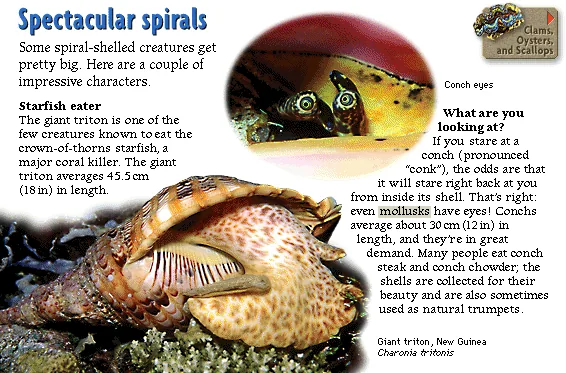
Some spiral-shelled creatures get pretty big. Here are a couple of impressive characters. Starfish eater The giant triton is one of the few creatures known to eat the crown-of-thorns starfish, a major coral killer. The giant triton averages 45.5 cm (18 in) in length.

What are you looking at?If you stare at a conch (pronounced "conk"), the odds are that it will stare right back at you from inside its shell. That's right: even mollusks have eyes! Conchs average about 30 cm (12 in) in length, and they're in great demand. Many people eat conch steak and conch chowder; the shells are collected for their beauty and are also sometimes used as natural trumpets.
Colorful cowries

Colorful cowries

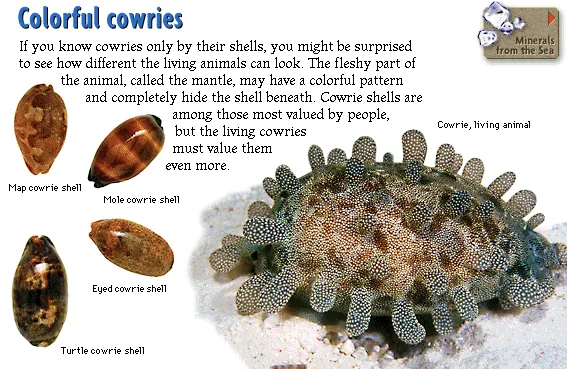
If you know cowries only by their shells, you might be surprised to see how different the living animals can look. The fleshy part of the animal, called the mantle, may have a colorful pattern and completely hide the shell beneath. Cowrie shells are among those most valued by people, but the living cowries must value them even more.

Watch

Shell collecting — Why gathering your own shells on the beach is the only way to be sure you're not promoting the killing of living animals.

Dive deeper

Source: Microsoft Oceans (1995) CD-ROM. Text liberated from original screen art; images, audio & clips restored from disc. Original media is Microsoft/supplier copyright — non-commercial educational preservation. Credits & Acknowledgements