Microsoft Oceans
Sea Urchins and Sea Cucumbers
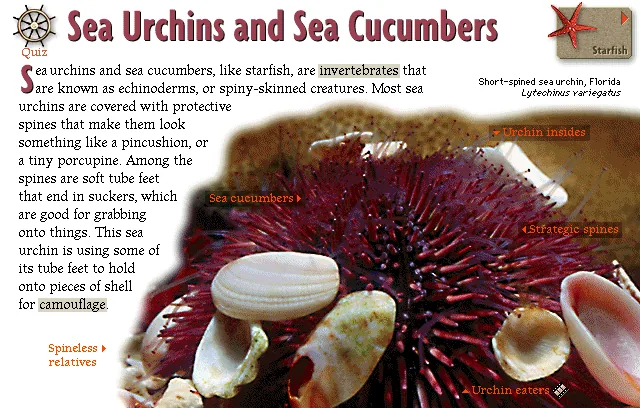
Lytechinus variegatus

Meet the ocean's prickly pincushion — and its sausage-shaped cousin!

Sea urchins and sea cucumbers, like starfish, are invertebrates that are known as echinoderms, or spiny-skinned creatures. Most sea urchins are covered with protective spines that make them look something like a pincushion, or a tiny porcupine. Among the spines are soft tube feet that end in suckers, which are good for grabbing onto things. This sea urchin is using some of its tube feet to hold onto pieces of shell for camouflage.

Explore

Urchin insides

Urchin insides

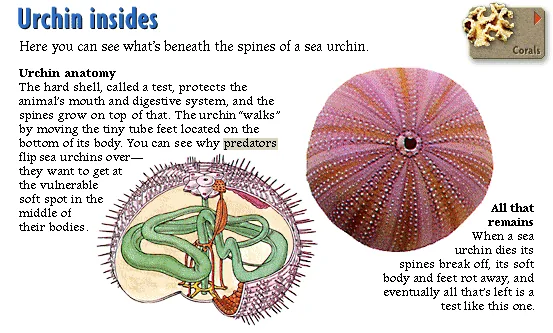
Here you can see what's beneath the spines of a sea urchin. Urchin anatomy The hard shell, called a test, protects the animal's mouth and digestive system, and the spines grow on top of that. The urchin "walks" by moving the tiny tube feet located on the bottom of its body. You can see why predators flip sea urchins over—they want to get at the vulnerable soft spot in the middle of their bodies.

All that remainsWhen a sea urchin dies its spines break off, its soft body and feet rot away, and eventually all that's left is a test like this one.
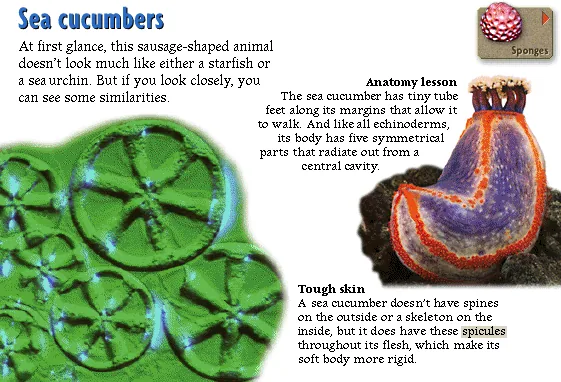
Sea cucumbers

Sea cucumbers

At first glance, this sausage-shaped animal doesn't look much like either a starfish or a sea urchin. But if you look closely, you can see some similarities.

Anatomy lessonThe sea cucumber has tiny tube feet along its margins that allow it to walk. And like all echinoderms, its body has five symmetrical parts that radiate out from a central cavity.
Tough skinA sea cucumber doesn't have spines on the outside or a skeleton on the inside, but it does have these spicules throughout its flesh, which make its soft body more rigid.
Spineless relatives

Spineless relatives

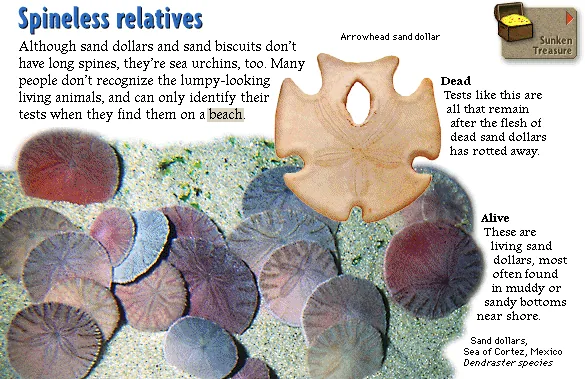
Although sand dollars and sand biscuits don't have long spines, they're sea urchins, too. Many people don't recognize the lumpy-looking living animals, and can only identify their tests when they find them on a beach.

DeadTests like this are all that remain after the flesh of dead sand dollars has rotted away.
AliveThese are living sand dollars, most often found in muddy or sandy bottoms near shore.
Strategic spines

Strategic spines

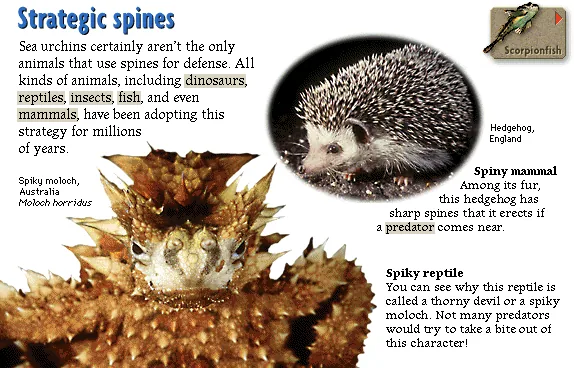
Sea urchins certainly aren't the only animals that use spines for defense. All kinds of animals, including dinosaurs, reptiles, insects, fish, and even mammals, have been adopting this strategy for millions of years.

Spiny mammalAmong its fur, this hedgehog has sharp spines that it erects if a predator comes near.
Spiky reptileYou can see why this reptile is called a thorny devil or a spiky moloch. Not many predators would try to take a bite out of this character!

Watch

Urchin eaters — You might think that no animal would want to bite down on the spines of a sea urchin. A few animals, like wolf eels, have mouths that are tough enough to crush the spines. Others resort to tricks to get their prey without getting injured. This queen triggerfish sucks in water, then blows it out in a sudden burst to flip the urchin over. The fish then rushes in and crunches through the sea urchin's abdominal shell, and the contest is over.

Dive deeper

Source: Microsoft Oceans (1995) CD-ROM. Text liberated from original screen art; images, audio & clips restored from disc. Original media is Microsoft/supplier copyright — non-commercial educational preservation. Credits & Acknowledgements