Microsoft Oceans
Sunken Treasure
Sunken Treasure

Fortunes lost at sea — and the daring people who hunt them.

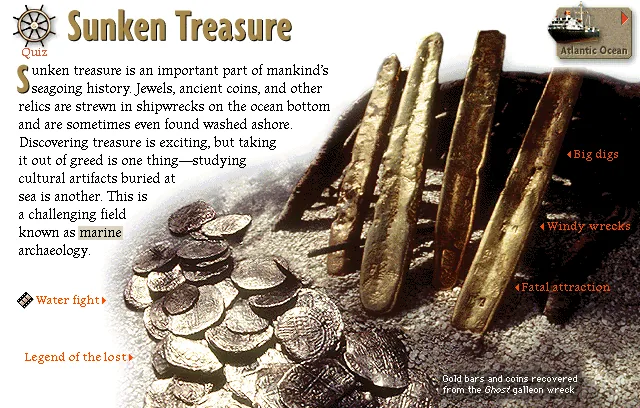
Sunken treasure is an important part of mankind's seagoing history. Jewels, ancient coins, and other relics are strewn in shipwrecks on the ocean bottom and are sometimes even found washed ashore. Discovering treasure is exciting, but taking it out of greed is one thing—studying cultural artifacts buried at sea is another. This is a challenging field known as marine archaeology.

Explore

Fatal attraction

Fatal attraction

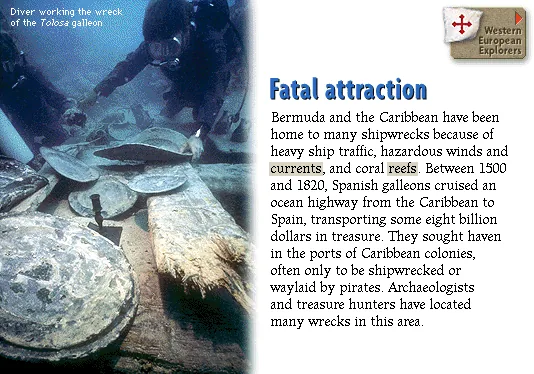
Bermuda and the Caribbean have been home to many shipwrecks because of heavy ship traffic, hazardous winds and currents, and coral reefs. Between 1500 and 1820, Spanish galleons cruised an ocean highway from the Caribbean to Spain, transporting some eight billion dollars in treasure. They sought haven in the ports of Caribbean colonies, often only to be shipwrecked or waylaid by pirates. Archaeologists and treasure hunters have located many wrecks in this area.

Tolosa galleonDiver working the wreck of the Tolosa galleon
Legend of the lost

Legend of the lost

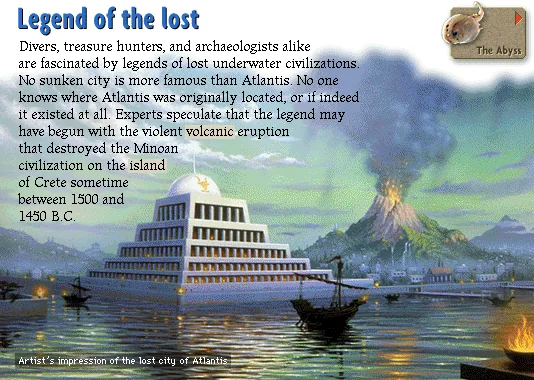
Divers, treasure hunters, and archaeologists alike are fascinated by legends of lost underwater civilizations. No sunken city is more famous than Atlantis. No one knows where Atlantis was originally located, or if indeed it existed at all. Experts speculate that the legend may have begun with the violent volcanic eruption that destroyed the Minoan civilization on the island of Crete sometime between 1500 and 1450 B.C.

AtlantisArtist's impression of the lost city of Atlantis
Windy wrecks

Windy wrecks

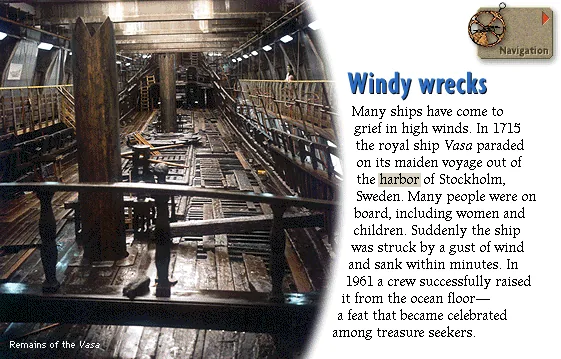
Many ships have come to grief in high winds. In 1715 the royal ship Vasa paraded on its maiden voyage out of the harbor of Stockholm, Sweden. Many people were on board, including women and children. Suddenly the ship was struck by a gust of wind and sank within minutes. In 1961 a crew successfully raised it from the ocean floor—a feat that became celebrated among treasure seekers.

The VasaRemains of the Vasa
Big digs

Big digs

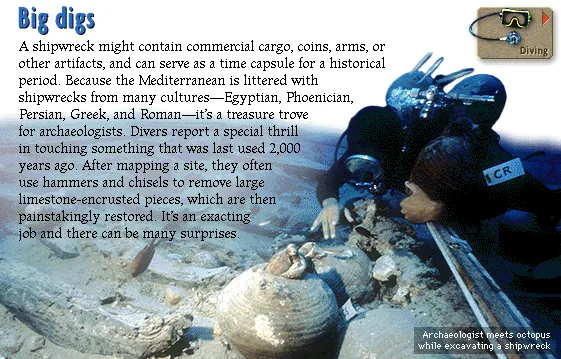
A shipwreck might contain commercial cargo, coins, arms, or other artifacts, and can serve as a time capsule for a historical period. Because the Mediterranean is littered with shipwrecks from many cultures—Egyptian, Phoenician, Persian, Greek, and Roman—it's a treasure trove for archaeologists. Divers report a special thrill in touching something that was last used 2,000 years ago. After mapping a site, they often use hammers and chisels to remove large limestone-encrusted pieces, which are then painstakingly restored. It's an exacting job and there can be many surprises.

ExcavationArchaeologist meets octopus while excavating a shipwreck

Watch

Water fight — Two divers at a contested underwater wreck site — the subject of ongoing disputes between treasure hunters, marine archaeologists, and environmentalists over excavation rights and ecosystem protection.

Dive deeper

Source: Microsoft Oceans (1995) CD-ROM. Text liberated from original screen art; images, audio & clips restored from disc. Original media is Microsoft/supplier copyright — non-commercial educational preservation. Credits & Acknowledgements